


The Science & Spirituality of ‘Becoming One with Nature’

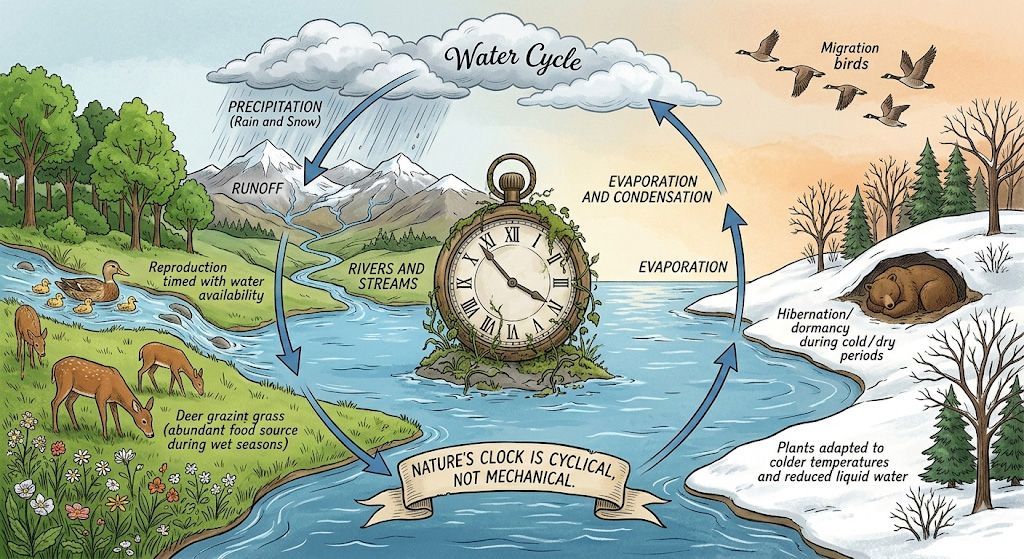
In the natural environment, we realize that nature’s energy is operating not on our mechanized time clock but in its own self-regulated operating cycle. The interacting forces of nature’s energy oscillate in predictable cyclical patterns. In this naturally occurring cyclical phenomena, resources like water are recycled to maintain conditions necessary for the existence of life. In a cyclical process of evaporation, water recycles from rain and snow to creeks, lakes, rivers, oceans, and back to rain and snow. These cyclical processes bring seasonal changes to the environment as well. All forms of life on planet earth biologically follow the cyclical patterns of nature. Plants wait for the season of spring to spur their growth. Animals synchronize their lifestyle with changes of seasons.

An illustration shows the water cycle as a clock face, cycling between lush green landscapes and snow-covered winters.

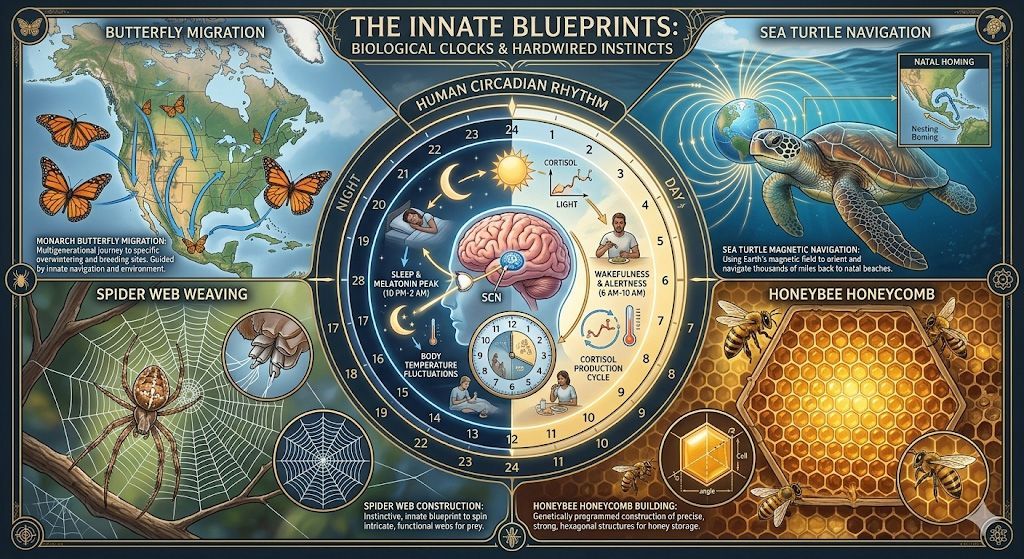
Biologically, humans have an innate circadian rhythm too. Circadian rhythm originates within an organism and responds to its surrounding environment. In the interest of its own fitness, an organism’s circadian rhythm syncs with the environment that supports its existence. Like the synchronized hardwiring for the biological existence of an organism, mind gets hardwired too, for instinctive actions of self-preservation. For example, the minds of Monarch butterflies have a gifted instinct to fly thousands of miles to specific forests. Sea Turtles instinctively return to the same place every year to breed guided by earth’s magnetic field in navigating oceans. Spiders instinctively weave web for their survival. Honeybees instinctively use an efficient hexagonal structural shape to store honey in their beehives.

An educational infographic titled

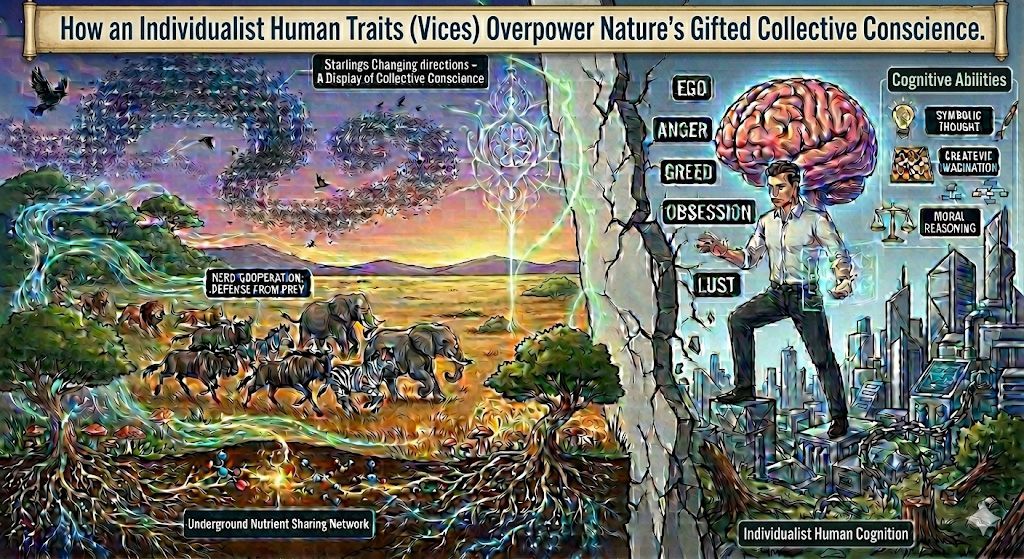
These instincts are not confined to an individual’s survival only but are hardwired for collective survival as well. Thousands of starlings fly in a group, collectively changing directions, without ever colliding. Herds of animals collectively run and defend themselves from animals of prey. Fungi create an underground sharing network of nutrients with trees. The existence of these instincts’ points to an underlying connectivity not only for physical fitness and self-preservation but for actions of collective conscience as well. However, in humans, due to the cognitive ability of our minds, nature’s gift of instincts gets easily subdued, either by our mind’s own rationales or from the influences of others. Thus, capabilities of the human mind get in the way of letting life unfold the way it should. In natural harmony, life should effortlessly flow like water around boulders in river.

A split-screen illustration showing a contrast between nature's collective consciousness and human individualistic greed.

To harmonize our actions with nature’s gifted instincts, we must develop a perception of what nature’s energy is. The word ‘energy’ is commonly used in many contexts. To describe its different attributes, use the word ‘spirit’ interchangeably. For example, the spirit of one sports team verses the other referring to how the spectator’s applause raised spirit of their players. A distinction in the use of the word energy verses the word spirit leaves a different impression on our minds. The word ‘energy’ is used for externally induced energy. For example, an energy drink, alcohol, or a drug is an externally induced energy. The applause mentioned above is an internal or psychologically induced energy.

Comparison of an athlete celebrating with internal energy versus a player on a bench fueled by an energy drink.

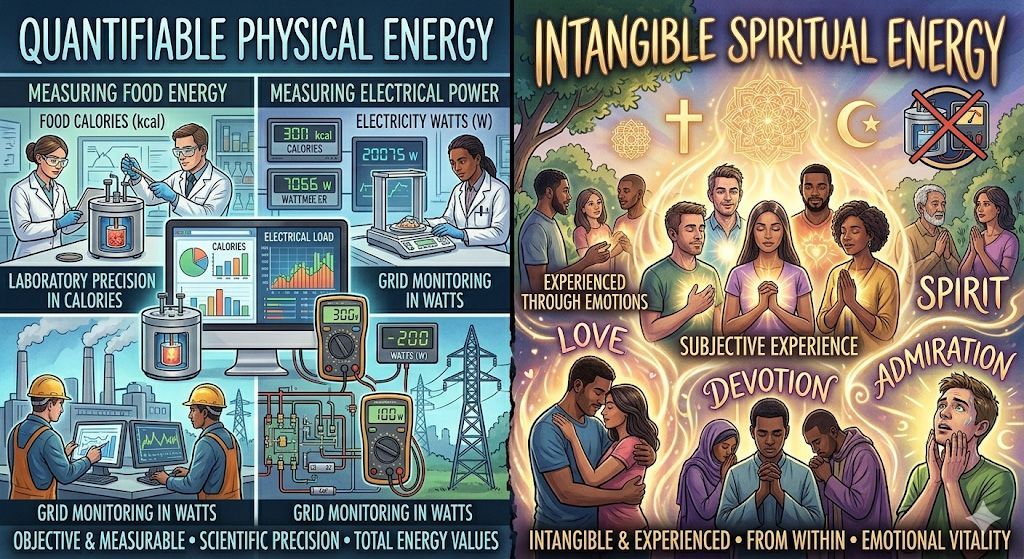
Another way to distinguish between energy and spirit is that energy implies a force of action that can cause change. Scientists quantify energy in various measures, for example energy of food is measured in calories, and electric energy in watts and kilowatts. The word ‘spirit’ on the other hand is used to express an intangible form of energy. It is expressed in terms of its intangible attributes. For example, love, devotion, admiration, and attachment are all intangible forms of energy that are experienced and subjective. This kind of energy cannot be measured. 

An infographic comparing Quantifiable Physical Energy (scientific, measurable) with Intangible Spiritual Energy (subjective).

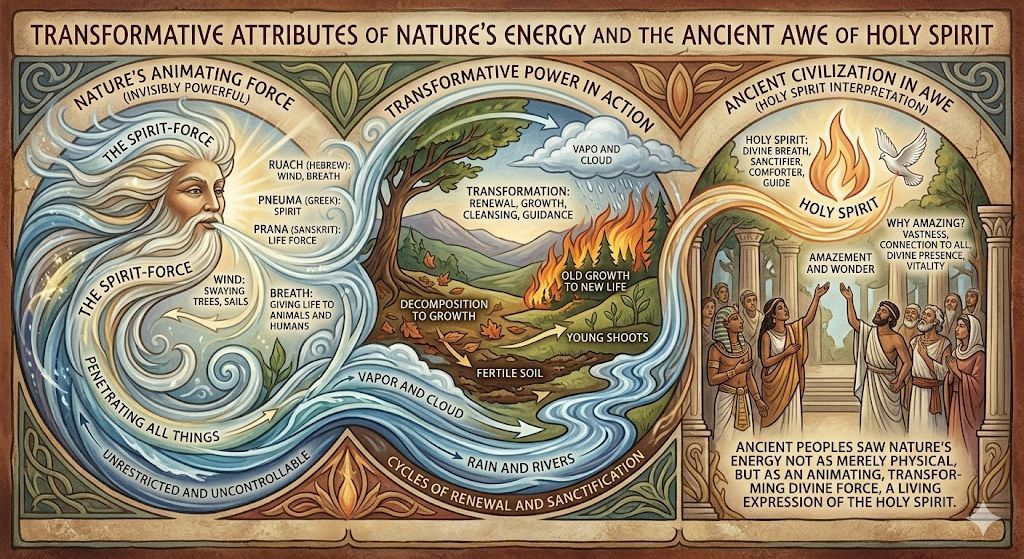
The evolutionary creation of the physical world from an intangible formless energy is considered a transcendental attribute of nature’s energy. Amazed at this transcendental aspect of nature’s energy, ancient civilizations distinguished this attribute by calling it the ‘Holy Spirit’. People who ‘believed’ in this transcendental attribute of nature’s energy were called ‘Spiritualists’. Thus, the use of the word ‘Spiritual’ is generally reserved to express inner beliefs.

A triptych illustration titled

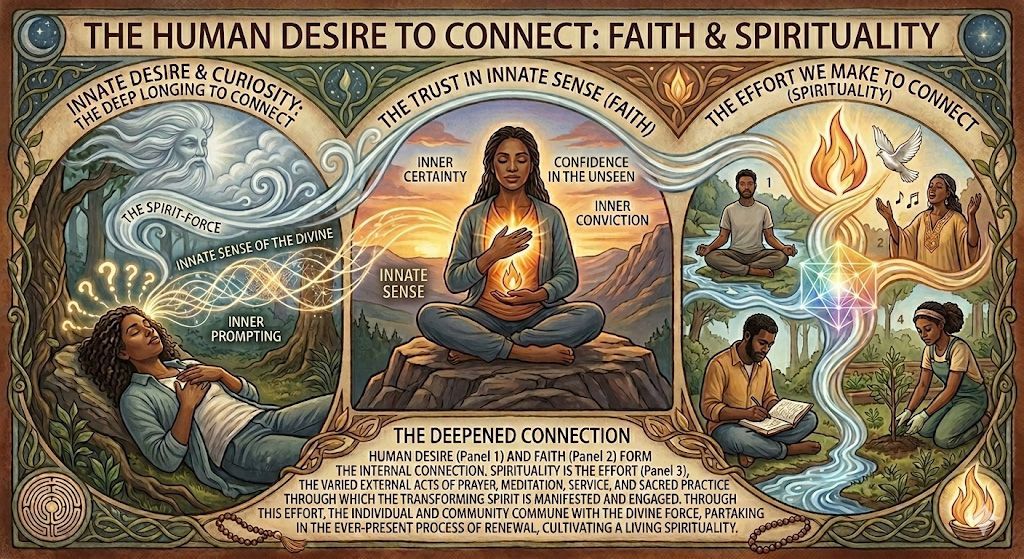
There is an innate human desire, curiosity, or sense that there is ‘something more’ than just us. We always carry that inherent feeling that ‘something more’ caused our existence. In whatever form of energy that ‘something more’ exists, and what we call it, is the prerogative of an individual’s perception. Whether we pursue these instincts to find out and connect with this ‘something more’ or not, is an individual’s choice, but doesn’t erase ‘innate sense’ that there is ‘something more’. That ‘trust’ in innate sense is ‘faith’. The ‘path’ we chose to find that ‘something more’ or to connect with it, is ‘spirituality’

An infographic titled

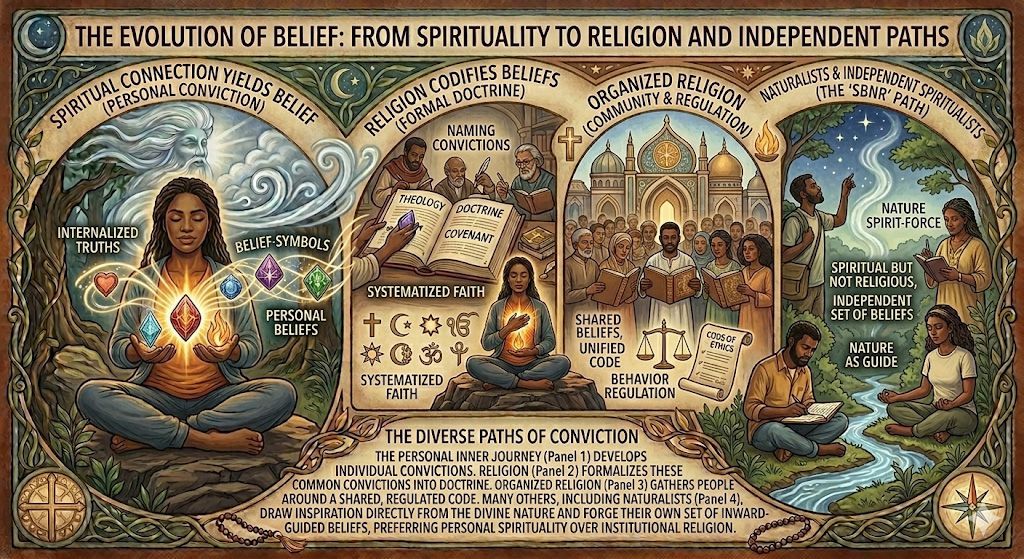
The ‘conclusions’ we draw from this ‘spiritual connection’ becomes our ‘belief’. Religion ‘codifies’ a set of beliefs. In an organized religion, a community not only shares a set of codified beliefs but regulates behavior of its members accordingly. People who pursue their own connection with that ‘something more’ by drawing inspiration from the majestic wonders of nature are called ‘naturalists’. Naturalists and many others who state that they are spiritual but not religious are implying that they are on their own path to connect with that ‘something more’. They are open minded to draw their own conclusions and develop their own set of beliefs.

An illustration depicting the evolution of belief through four panels, from personal meditation to religion and nature.

The following statistics give us a perception of the current viewpoints of Americans:

American Spiritual Experience with Nature of Americans Religious & Spiritual Identities in US % of Americans
Feel In Awe with its Beauty 93% Spiritual & Religious 48%
Feel Spiritual Peace 74% Spiritual but not Religious 22%
Feel the Presence of Something Beyond 61% Neither Spiritual nor Religious 21%
Believe Nature has Spiritual Energies 48% Religious but not Spiritual 10%

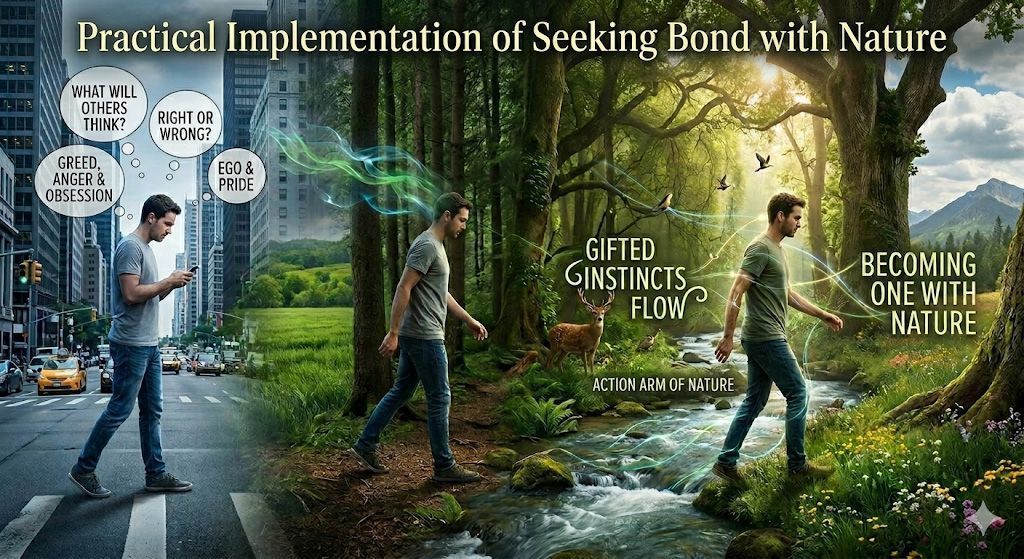
The above statistics imply that most of us seek to bond with nature by becoming part of it. We seek to experience our own existence not as an ‘observer’ of natural phenomenon but as ‘participant’ of it. The practical implication of being a ‘participant of this phenomenon is to maintain a ‘trust’ in our ‘instincts’. At the urging of our mind, we tend to calculate our actions based on criteria like “what others will think”. Also, we let our pride and ego interfere in deciding “what is right or wrong”. Such calculations separate us from the moral compass of nature’s gifted instincts. In natural flow instincts, we act not as a ‘tourist’ on earth but as a contributor to the natural processes. Psychologically, it implies a mindset shift, wherein we become an extension of nature’s energy. In interconnected nature’s energy, a mindset of collective conscience, instinctively protects the life and environment of planet earth. In these instinctual acts of collective conscience, we become ‘One’ with nature’s energy.

A man transitions from a busy city street to a lush forest, illustrating a move from digital distraction to nature.

Psychologists call this instinctual behavior of collective conscience ‘natural disposition’. Natural disposition is inherently ‘Altruistic’ because an urge to help others in need, emerges from the instincts of collective conscience. Connectedness has become the catalyst of synergy between science and spirituality. According to the Theory of Entanglement, in Quantum physics, the universe is made up of energy fields. Different frequencies of vibration in energy fields transform into particles of energy, whose interaction results in the evolution of innumerable physical forms. Vibrating frequencies interconnect everything in the universe, like the rolling impact of waves on ships, boats, ferries, and fish; no matter how big, small, deep or shallow, their physical form and position is, in the ocean or river. 

An ink illustration of a wave curling around a coastal house and a whale, with surfers and boats amidst the swirling water.

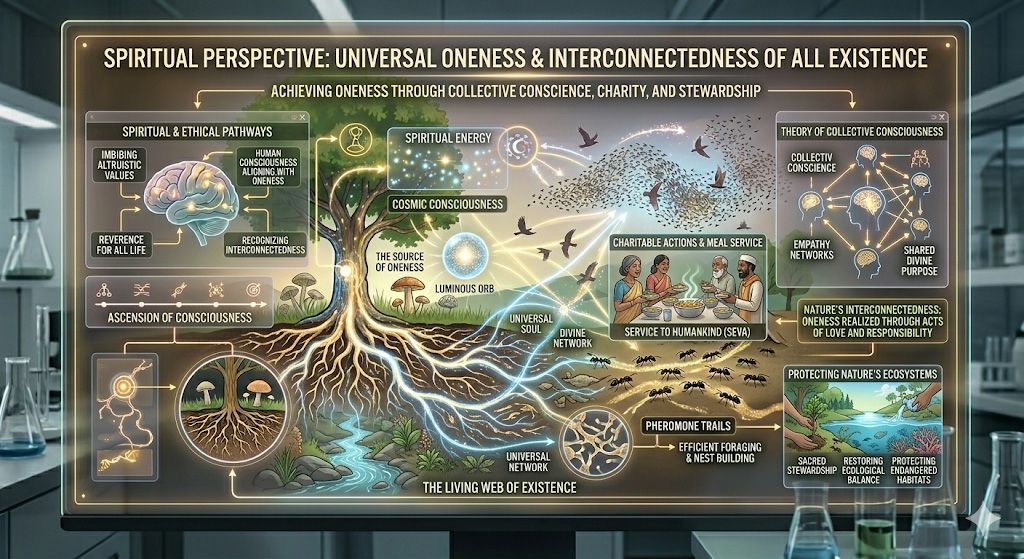
Spiritualists, on the other hand describe this interconnection in terms of ‘Oneness’. Unlike scientists, who methodically rationalize their theories, spiritualists rely on an intangible emotional experience. To a spiritualist, Oneness is an intangible spiritual experience, wherein connection with everything in existence is felt. Thus, connectedness has become the point of synergistic convergence between the spiritual concept of ‘Oneness’ and the scientific “Theory of Entanglement”. This starting point of synergy has led to a convergence of perceptions not only in concepts but in moral values as well.

A digital display shows a complex diagram illustrating universal interconnectedness through nature, science, and humanity.

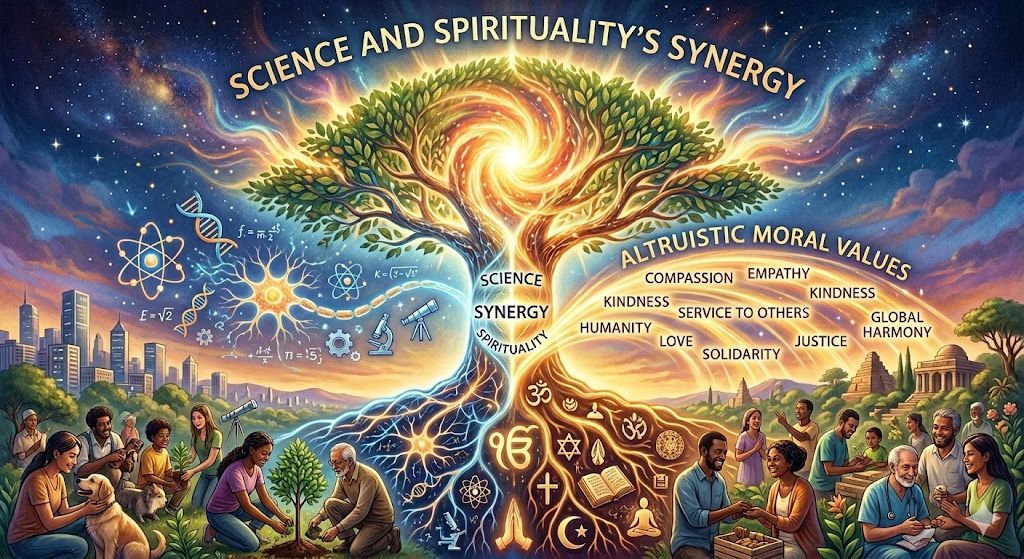
A point of contrast between the rational theories of science and the beliefs of spiritual wisdom has been that unlike spiritual beliefs, scientific theories cannot become an anchor of society’s moral values. Thus, spiritual beliefs offer the basis of moral values to a society which scientific theories cannot. However, due to this newfound synergy between science and spirituality, ‘Altruistic’ values have emerged as the common theme. The mental health benefits of ‘Altruistic’ actions has been scientifically validated. With ‘Altruism’ as the common platform of moral values between science and spirituality, many ancient tools and techniques of spirituality used to achieve the goal of ‘Oneness’ have become a subject of interest, in many fields of science.

A surreal illustration depicts a central tree symbolizing the synergy of science and spirituality, surrounded by humanity.

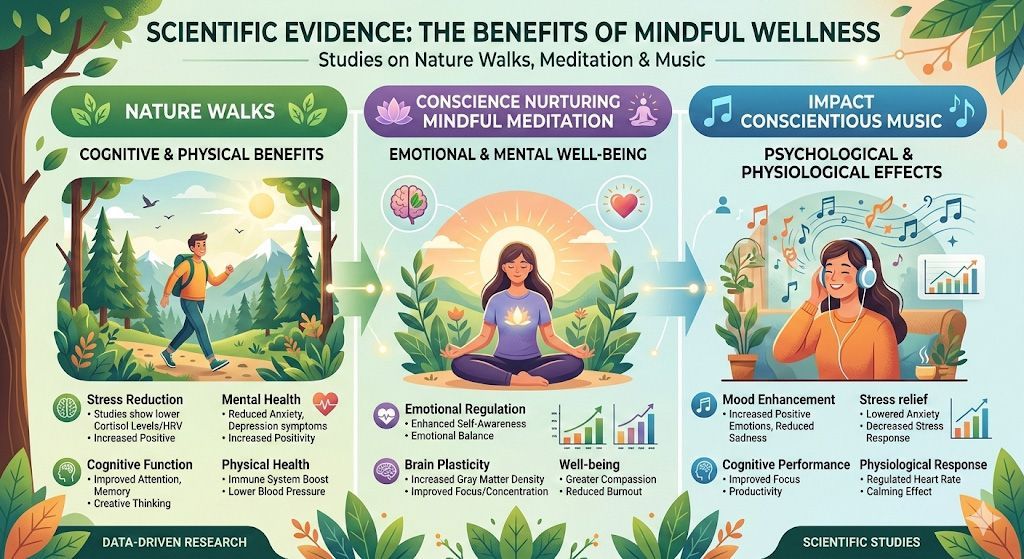
Psychologists, Neurologists, and Cell Biologists studied and validated the impact and effectiveness of forest bathing, nature walks, mindful meditations and conscientious music on the mind. In the next few articles, we will explore this synergy of science and spirituality by delving into the topics of natural disposition, ‘Altruistic’ conscience, the workings of the mind and conscience, nurturing of conscience, the impact of the natural environment, mindful meditations, and the use of music as a tool to sustain conscientious natural harmony.

An infographic on the scientific benefits of nature walks, meditation, and music for mindful wellness.

Our intention of exploring science and spirituality’s synergy is to spark a contemplative journey to a path and lifestyle that leads us in the direction of conscientiously becoming ‘One’ with nature.

A person with a backpack walks away along a sunlit, green forest trail.

Recent Posts

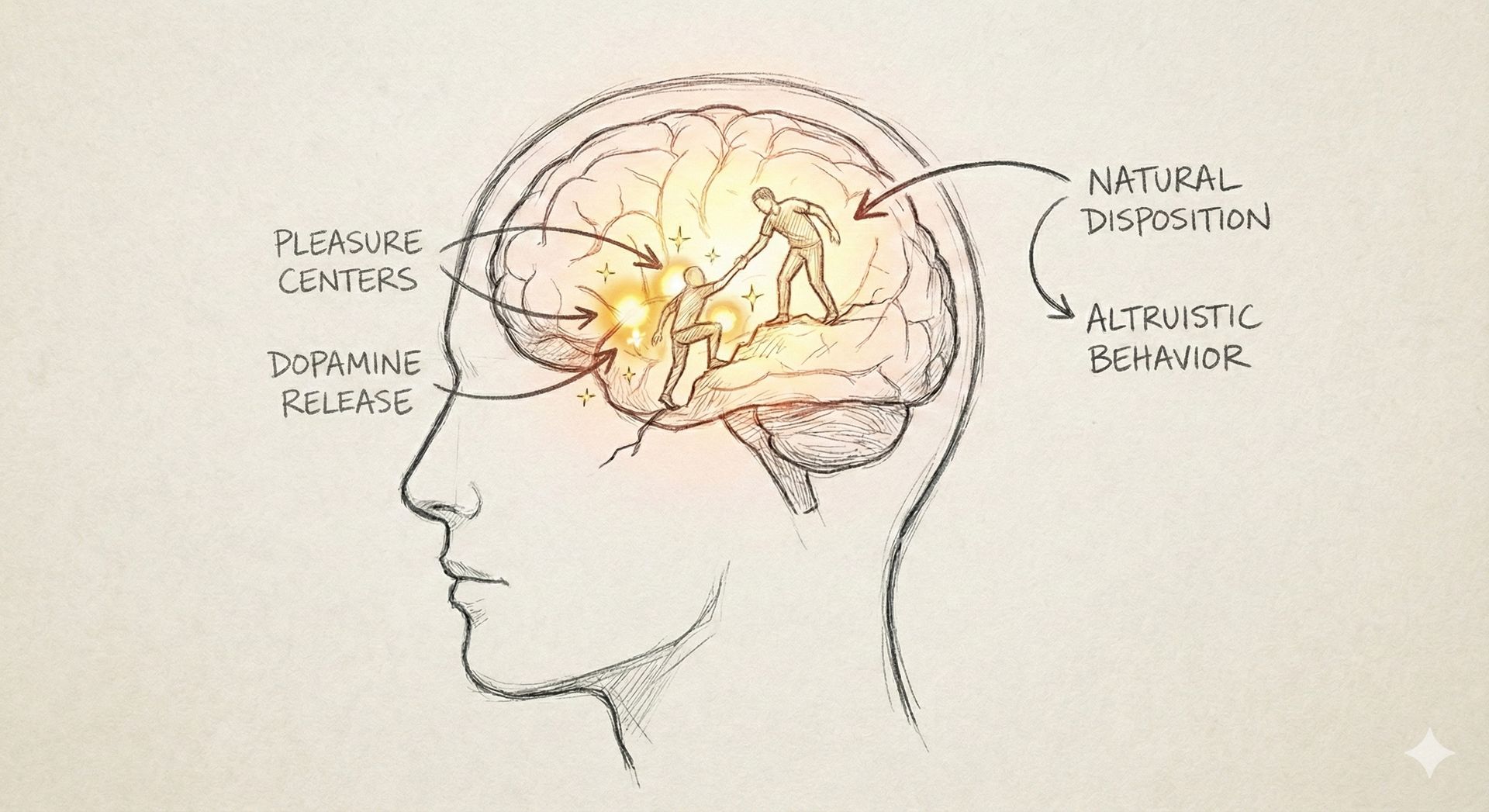
A drawing of a human head shows a bright glow in the brain labeled
March 16, 2026
Becoming One with nature implies that our actions are aligned with the attributes or characteristics of nature’s energy. Any particular action that happens naturally is considered an action of natural disposition. Our energy is composed of nature’s elements. Thus, the characteristics of nature’s energy shape our natural dispositions. Neuroscientists have provided brain scans evidencing that actions of ‘Altruistic’ behavior activate the pleasure centers of the brain. Altruism is a natural motivation to help others in need, without any expectation of favor. Spiritual wisdom of ‘Altruistic’ behavior has existed since the dawn of civilization. Thus, the natural disposition of ‘Altruistic’ behavior has become the newfound common theme of synergy between the psychologists and spiritualists. However, it is the mechanics of our conscientious mind that sustains the strength of nature’s gifted instincts.
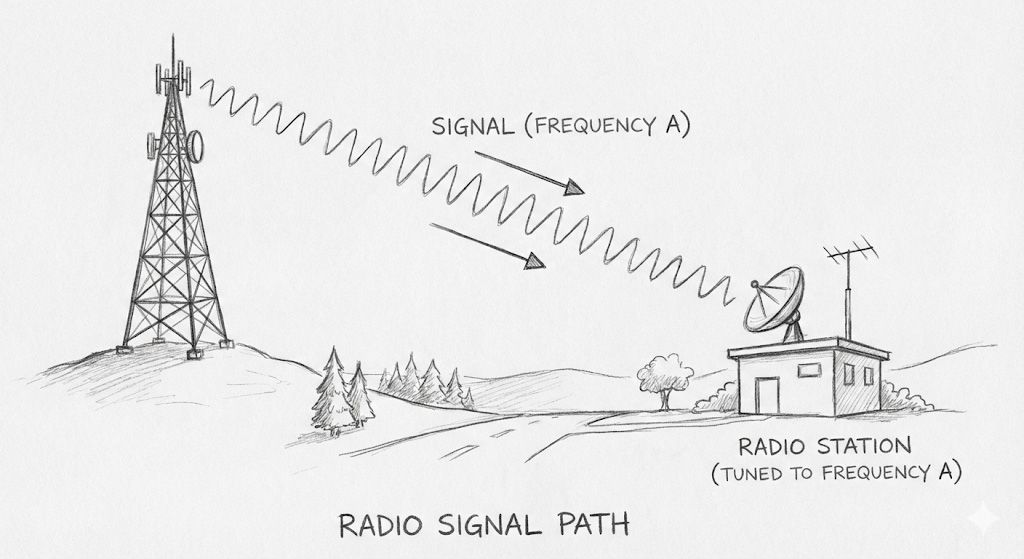
A radio tower transmits a signal at a specific frequency to a radio station equipped with a satellite dish.
March 15, 2026
Conscious and conscience are similar sounding words but have very diƯerent meanings. The buildup of conscience is a progressive process of the mind because its development depends upon the memories of past experiences, current thinking and constantly changing outside influences. Cell biologists have discovered that our cell structure is not only capable of networking with other cells in our body but can sense signals from the outer environment as well. This article explains the crucial role our mind’s conscience plays in aligning our convictions with nature’s energy. In spiritual terms, this conscientious connection is like a soul’s connection with its creator. Tuning our mind’s conscience to nature’s energy is comparable to the tuning of a radio station’s signal frequency to the frequency of a transmission tower. This process of frequency tuning is like nurturing our conscience by immersing ourselves in nature’s energy.

A sketch of a faucet running brown, muddy water into an overflowing bowl, with text reading
March 14, 2026
We can nurture our mind’s conscience to align our actions with nature’s gifted instincts. For ages, spiritualists have used the technique of meditation to nurture their conscience. Neuroscientists have evidence of brain scans that prove their eƯectiveness. Mindful meditation is now considered the most eƯective drug free treatment for many mental health related issues. Whether it is depression, PTSD, addiction, or a nervous breakdown, guided meditation helps enhance focus of mind and gives direction to its thought process. This article highlights the synergy in science and spirituality for the use of this technique to sustain an ‘Altruistic’ conscience of natural disposition. With an analogy of a running faucet of freshwater replacing muddy water in a bowl under it, this article explains how the thoughts of a distressed mind can be replaced with thoughts that nurture a conscience of natural harmony.